
Perplexity is an AI-powered answer engine that searches the web and generates responses supported by links to source material. It combines information retrieval with generative AI to help users research topics, answer questions and explore follow-up queries.
Introduction
The service is intended for individuals, students, researchers, developers and organizations that need a conversational way to find and summarize information. Instead of presenting only a conventional list of search results, it produces a written answer and identifies the online sources used to construct that answer.
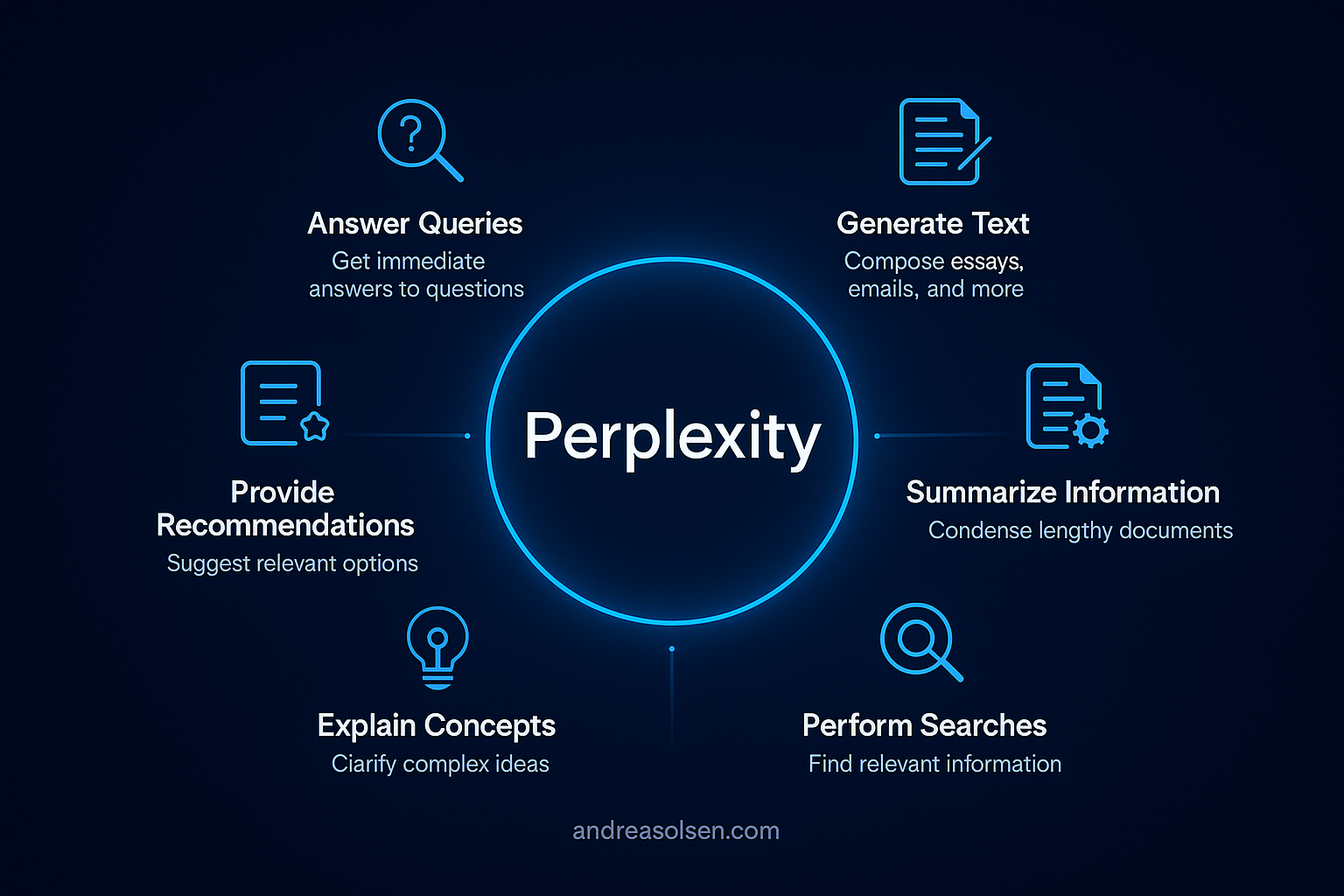
Someone might use Perplexity to obtain an overview of an unfamiliar topic, compare products, research a market, review technical documentation or locate supporting sources. Its citations make it easier to inspect the underlying material, although users should still verify important claims against primary and authoritative sources.
Quick Facts
| Item | Details |
|---|---|
| Developer | Perplexity AI, Inc. |
| Founded | 2022 |
| Headquarters | San Francisco, California, United States |
| Category | AI answer engine and web research software |
| Platforms | Web, iOS, Android and macOS |
| Deployment | Cloud-based software as a service |
| Free Plan | Yes, a Standard plan is available |
| Paid Plans | Yes, including Pro, Max and organizational plans |
| API | Yes, through the Perplexity Sonar API |
| Open Source | No, the Perplexity service is proprietary |
| Mobile Apps | Yes, for iOS and Android |
| Official Website | Perplexity |
What Is Perplexity?
Perplexity is a search and research service built around a conversational interface. A user enters a question in natural language, and the system searches for relevant information, processes the retrieved material and produces a summarized response with citations.
The citations generally appear as numbered references or linked sources associated with statements in the answer. Users can open those sources, assess their relevance and compare the generated summary with the original material. Follow-up questions remain connected to the current thread, allowing the user to narrow, expand or clarify the research topic.
This approach addresses several common search problems. It can reduce the time required to open numerous pages, extract basic facts and assemble an initial overview. It also gives users direct access to source links rather than presenting generated text without attribution.
Perplexity does not eliminate the need for verification. Generative AI systems can misunderstand sources, omit context or produce statements that are not fully supported by the cited page. The authority, publication date and relevance of each source should be evaluated, especially for medical, legal, financial, academic or business-critical decisions.
Typical users include consumers researching purchases or travel, students gathering background information, professionals monitoring industries and developers adding web-grounded answers to applications. Organizations can also use enterprise features to search approved internal material alongside information from the web.
Key Features
- Conversational web search: Users can ask questions in everyday language and receive synthesized answers based on information retrieved from the web. A thread can continue through follow-up questions without requiring the full subject to be restated each time.
- Source citations: Answers include links to web sources so that users can inspect the material behind the response. Citations improve traceability, but their presence does not guarantee that every sentence is accurate or fully supported.
- Pro Search: Paid access includes an enhanced search workflow designed to perform more extensive research and provide detailed responses. Usage allowances and access conditions are determined by the applicable plan.
- Research mode: Perplexity documents a research capability that conducts multiple searches, evaluates sources and produces a longer report. It is intended for questions that require more than a short answer or a single search.
- Advanced AI model access: Paid plans provide access to advanced models made available through Perplexity. The available model selection may change as providers and product plans are updated.
- File analysis: Users can upload supported documents and ask questions about their contents. This can help summarize a report, locate information within a file or compare uploaded material with web sources.
- Image input and generation: Supported plans provide visual capabilities, including asking questions about uploaded images and generating images. Availability and limits depend on the plan and current product configuration.
- Spaces: Spaces organize research by subject or project. They can include custom instructions, selected sources, uploaded files and collaboration options, making them useful for maintaining context across related threads.
- Search history and library: Signed-in users can return to previous threads and saved research. This provides continuity for topics that require repeated searches or later review.
- Mobile applications: Official iOS and Android applications provide access to conversational search on mobile devices. Perplexity has also documented voice-based interaction in its mobile products.
- Sonar API: Developers can use Perplexity’s API to add web-grounded AI responses to their own applications. API models, context limits and usage charges are documented separately from consumer subscriptions.
Use Cases
General research is one of the most direct uses. A user can request a plain-language explanation, ask for a comparison and then examine the cited articles, reports or official pages. This works well during the early stages of research when the objective is to understand terminology and identify useful sources.
Market and competitor research can involve collecting recent public information about companies, products or industry developments. Teams can ask follow-up questions and organize related searches in a Space, but financial figures and strategic decisions should be checked against company filings and other primary documents.
Content planning may involve researching a topic, identifying recurring questions and collecting sources before writing. Perplexity can support research and outlining, but publishers remain responsible for originality, fact-checking, copyright compliance and editorial quality.
Academic discovery can help students learn unfamiliar concepts or locate potentially relevant publications. It should not replace academic databases, direct reading of papers or required citation practices. Institutional rules also determine whether and how generated material may be used in coursework.
Technical research includes finding documentation, comparing software approaches and obtaining explanations of programming concepts. Developers should test code and consult the official documentation for the relevant language, framework or service before using results in production.
Travel and purchasing research can combine comparisons, recommendations and current web information in one thread. Prices, availability, entry requirements and product specifications can change, so final details should be confirmed with the relevant seller, government agency or service provider.
Internal knowledge discovery is available to eligible organizations through supported file and content connectors. This can help employees search approved company sources while using a conversational interface. Access remains subject to the organization’s plan, administrator settings and source permissions.
Application development is supported through the Sonar API. A developer might use it for a research assistant, monitoring tool or support workflow that requires answers grounded in current web results. The developer remains responsible for application design, validation, security and compliance.
Pricing & Plans
Perplexity offers a free Standard plan. It provides basic search functionality and limited access to more advanced capabilities, making it possible to use the core answer engine without a paid subscription.
Perplexity Pro is publicly priced at $20 per month or $200 per year. It adds higher usage allowances and access to paid capabilities such as Pro Search, advanced AI models, file analysis and image features. Exact usage limits are displayed in Perplexity’s current plan documentation and may be changed by the provider.
Perplexity Max is publicly priced at $200 per month or $2,000 per year. It is positioned above Pro and provides expanded access to Perplexity’s advanced product capabilities. Users should compare its current allowances with Pro before subscribing because availability and limits can differ by feature.
Perplexity also publishes organizational offerings, including Enterprise Pro. Public pricing for Enterprise Pro is $40 per seat per month or $400 per seat per year. Enterprise features include administrative controls, collaboration and access to supported internal knowledge sources.
The Sonar API uses separate usage-based pricing rather than the consumer subscription structure. Charges depend on the API model and usage measured under the current official API pricing documentation. Consumer subscriptions should not be assumed to include unlimited API use.
Prices, taxes, plan names and included allowances can change or vary according to billing conditions. The checkout page and official pricing documentation provide the applicable terms at the time of purchase.
Pros & Cons
Pros
- Responses include links to sources, allowing users to inspect the underlying web pages.
- The conversational format supports follow-up questions and progressive refinement of a topic.
- A free plan provides access to the core search and answer experience.
- Research mode can handle broader questions that require multiple searches and a structured report.
- Spaces help separate projects and maintain relevant instructions, files and sources.
- Official web, mobile and macOS access supports use across multiple device types.
- The Sonar API gives developers a documented method for adding web-grounded responses to applications.
- Enterprise options provide administrative and internal knowledge features for organizations.
Cons
- Generated answers can contain errors, incomplete context or conclusions that are not fully supported by the cited material.
- Citation quality depends on the relevance and authority of the sources selected by the system.
- Advanced features and higher usage allowances require a paid plan.
- Model availability, feature limits and plan allowances can change over time.
- The cloud-based service requires internet access and processing by an external provider.
- It does not replace primary-source review or professional advice in high-risk subject areas.
- The service is not open source, so its complete production code and search-ranking processes are not available for independent inspection.
- API usage is billed separately according to the selected model and consumption.
Integrations
Perplexity officially supports internal knowledge connectors for eligible organizational accounts. Documented connectors include Google Drive, Microsoft OneDrive, Microsoft SharePoint, Dropbox and Box. These connectors allow authorized content to be included as a source when users search internal knowledge.
Connector availability depends on the organization’s plan and administrator configuration. Existing permissions remain important because users should only be able to retrieve content they are authorized to access. Organizations should review Perplexity’s current security, retention and connector documentation before connecting sensitive repositories.
The Sonar API provides a separate integration path for custom software. Developers can send requests to supported Perplexity API models and incorporate returned answers and citations into their own systems. This requires development work and should not be treated as a prebuilt integration with every external application.
Who Should Use Perplexity?
Perplexity is most relevant to users who want concise, conversational answers while retaining the ability to open supporting sources. It can be useful for people who find conventional search result pages inefficient during the initial stages of research.
Researchers, analysts, journalists and marketers can use it to discover sources, monitor public information and develop an initial understanding of a subject. They still need independent verification and should prioritize original records, official statements and other primary evidence.
Students and educators may find it useful for explanations, topic exploration and source discovery. Its use should follow school or university policies, and generated text should not be represented as original work when that would violate academic rules.
Software developers can use the web interface for technical research or the Sonar API for custom applications. Businesses in technology, consulting, finance, media, retail and other research-intensive industries may also benefit from Spaces, administrative features and supported internal knowledge connectors.
Perplexity is less suitable as the sole source for decisions requiring guaranteed accuracy. Users who need fully controlled on-premises deployment, open-source code or deterministic output may need a different product or a separately validated research process.
Frequently Asked Questions
Is Perplexity free?
Yes. Perplexity offers a free Standard plan that includes its core conversational search experience and limited access to selected advanced functions. Paid plans provide higher allowances and additional capabilities. Perplexity Pro is publicly priced at $20 per month or $200 per year, while Max and organizational plans serve users with broader requirements. API use follows separate usage-based pricing.
What is Perplexity used for?
Perplexity is used to search the web, summarize information and answer questions with citations. Common tasks include general research, source discovery, product comparisons, technical research, market monitoring and document analysis. Users can ask follow-up questions, organize related work in Spaces and, on eligible plans, search connected internal content. Developers can also build web-grounded applications with the Sonar API.
Is Perplexity worth it?
Its value depends on research volume, required features and tolerance for AI-generated errors. The free plan allows users to assess the core workflow without paying. A paid plan may be useful to people who need higher limits, advanced models, deeper research or file features. It may offer less value when conventional search is sufficient or when every result requires extensive independent verification.
Who should use Perplexity?
Perplexity can serve students, researchers, analysts, writers, developers and business teams that regularly gather information from the web. Organizations may use enterprise features for controlled access and internal knowledge search. It is best treated as a research aid rather than an unquestioned authority. Medical, legal, financial and other high-impact information should be confirmed through qualified professionals and authoritative primary sources.
What are the best alternatives to Perplexity?
Alternatives include Google Search for conventional web discovery, ChatGPT Search for conversational web answers, Microsoft Copilot for AI assistance connected to Microsoft’s ecosystem, and Google Gemini for Google’s AI assistant and search-related workflows. Claude is another option for document analysis and general AI assistance. The most appropriate choice depends on citation needs, data policies, integrations, model access, pricing and preferred workflow.
Conclusion
Perplexity combines web search, generative AI and source citations in a conversational answer engine. Its main functions include question answering, follow-up research, file analysis, organized Spaces, deeper research workflows and API access for developers.
It is best suited to people and organizations that frequently investigate topics and want a synthesized starting point with links to supporting material. Key strengths include accessible citations, conversational refinement, cross-platform availability and both individual and enterprise options.
Its primary limitations are those associated with generative AI and automated source selection. Answers may be inaccurate, citations may not fully support a claim, and advanced access requires paid plans. Important conclusions should therefore be checked against reliable primary sources and, where appropriate, qualified professional advice.
🤖 About This Guide
This guide was created using a custom AI-powered automation workflow built with n8n, OpenAI and WordPress.
The system automatically researches, writes, formats and publishes objective software tool reviews while maintaining a consistent structure, editorial quality and SEO best practices.