
ChatGPT is a conversational artificial intelligence service developed by OpenAI. It accepts natural-language instructions and can generate text, analyze uploaded content, work with images, search the web and assist with tasks such as writing, research, coding and data analysis.
The service is intended for individuals, professionals, developers, educators and organizations. People use it to obtain explanations, draft or revise content, explore information, analyze documents and accelerate routine knowledge work.
ChatGPT is available through a web interface and official mobile and desktop applications. Its capabilities, model access and usage limits depend on the selected plan, region, device and workspace settings.
Quick Facts
| Item | Details |
|---|---|
| Developer | OpenAI |
| Founded | OpenAI was founded in 2015 |
| Headquarters | San Francisco, California, United States |
| Category | Artificial intelligence and conversational AI |
| Platforms | Web, iOS, Android, macOS and Windows |
| Deployment | Cloud-hosted service with web, mobile and desktop applications |
| Free Plan | Yes |
| Paid Plans | Plus, Pro, Business and Enterprise; OpenAI also provides an education-focused offering |
| API | OpenAI provides a separate developer API; ChatGPT subscriptions do not include API usage |
| Open Source | No |
| Mobile Apps | Official iOS and Android applications |
| Official Website | https://chatgpt.com/ |
What Is ChatGPT?
ChatGPT is an AI assistant that interacts through typed or spoken conversations. A user submits a prompt, and the service processes the prompt with an OpenAI model before returning a generated response. Users can continue the conversation, request revisions or provide additional context.
The underlying models are trained to identify patterns in data and generate an appropriate continuation based on the instructions and available context. ChatGPT does not retrieve every answer from a fixed database. Depending on the feature being used, it may rely on model knowledge, information supplied by the user, uploaded files, connected services or current web search results.
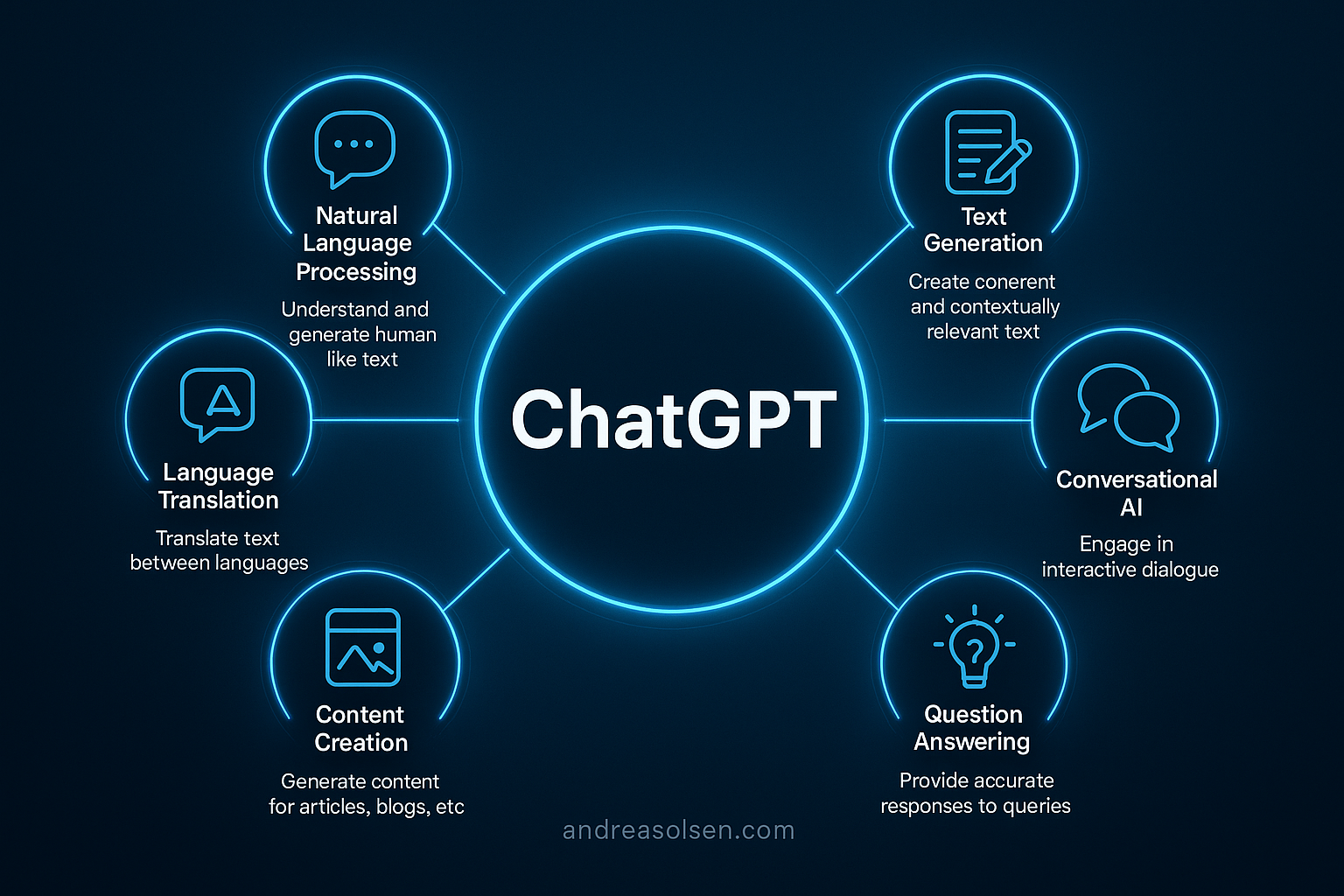
The service addresses tasks that would otherwise involve drafting, summarizing, classifying, translating, brainstorming or reviewing information manually. It can explain technical subjects at different levels, transform content into a requested format and help users reason through structured problems.
ChatGPT is used by consumers as well as teams in fields such as software development, marketing, customer operations, education, research and administration. It is a general-purpose service rather than an industry-specific system, so the suitability of an output depends on the task, instructions and required level of accuracy.
OpenAI states that ChatGPT can make mistakes. Generated answers should therefore be checked when they affect legal, medical, financial, academic, security or business decisions. Web citations and source links can help with verification, but their presence does not remove the need to evaluate the underlying sources.
Key Features
The features available in ChatGPT vary by plan and may have usage limits. OpenAI also changes model availability and product limits over time, so a feature visible in one account may not be available in another account or workspace.
- Conversational text generation: ChatGPT can answer questions, produce drafts, rewrite passages, summarize text, translate content and follow formatting instructions through a multi-turn conversation.
- Web search: ChatGPT can search the web for current information and present links or citations associated with its response. Search is useful when a question depends on information that changes over time.
- File uploads and analysis: Supported accounts can upload documents, spreadsheets, presentations and other supported file types. ChatGPT can summarize content, extract information, answer questions about files and perform analysis.
- Data analysis: ChatGPT can use a code-execution environment for calculations, data processing and chart creation. Users can upload structured data and describe the analysis they want to perform.
- Image understanding: Users can provide images and ask questions about visible content. Common applications include interpreting diagrams, reading text in an image and discussing a photograph or screenshot.
- Image generation: ChatGPT can create and edit images from natural-language instructions when image capabilities are available to the account.
- Voice conversations: Official mobile and desktop experiences support spoken interaction. Users can speak to ChatGPT and receive audible responses, subject to plan and platform availability.
- Memory: When enabled, memory allows ChatGPT to retain selected information across conversations. Users can review, remove or disable saved memories through the available controls.
- Projects: Projects organize related conversations, files and instructions in one workspace. They are designed to provide ongoing context for a particular body of work.
- Canvas: Canvas provides a separate working area for collaborative writing and coding. It allows users to edit content directly and request focused changes to selected material.
- Custom GPTs: Users can create configured versions of ChatGPT with specific instructions, knowledge files and selected tools. Availability for creating, sharing or managing GPTs depends on the plan and workspace controls.
- Deep research: This capability conducts multi-step online research and produces a documented response using discovered sources. Access and usage allowances vary by plan.
Use Cases
Writers and marketing teams can use ChatGPT to produce outlines, compare wording options, summarize research and adapt existing material for different audiences. Human review remains important for factual accuracy, brand requirements, originality and legal compliance.
Software developers can request code explanations, debugging ideas, test cases, documentation and examples in supported programming languages. Generated code should be reviewed and tested because it may contain functional errors, insecure patterns or dependencies that do not match a project.
Analysts and operations teams can upload supported spreadsheets or documents and ask for summaries, calculations or visualizations. This can reduce time spent on exploratory work, although important figures should be validated against the original data and established analytical methods.
Students can use the service to request explanations, practice questions, study plans and feedback on their own writing. Educators can use it to explore lesson structures or examples, but institutional policies and academic-integrity requirements may restrict how generated work is used.
Business users can draft meeting agendas, summarize non-sensitive notes, prepare internal documentation and organize ideas. Organizations handling confidential, personal or regulated information should evaluate the applicable plan, data controls, retention settings and internal policies before uploading material.
Individuals can use ChatGPT for travel research, language practice, meal ideas, personal organization and explanations of unfamiliar topics. Current details such as schedules, regulations, prices and availability should be confirmed through authoritative sources.
Pricing & Plans
OpenAI publishes several ChatGPT plans. Prices shown by OpenAI may exclude applicable taxes, and billing options or plan availability can vary by country. Usage limits are not necessarily fixed and may change according to model capacity and service conditions.
| Plan | Published price | General positioning |
|---|---|---|
| Free | US$0 | Entry-level access with limits on models and tools |
| Plus | US$20 per month | Individual subscription with expanded access and higher limits than the Free plan |
| Pro | US$200 per month | Individual subscription providing higher levels of access to supported models and capabilities |
| Business | US$25 per user per month when billed annually, or US$30 per user per month when billed monthly | Collaborative workspace with administrative and organizational data controls |
| Enterprise | Information not publicly available. | Enterprise deployment with additional administration, security and support arrangements |
| Education offering | Information not publicly available. | Designed for deployment by educational institutions |
ChatGPT subscriptions and OpenAI API billing are separate. Paying for Plus, Pro, Business or Enterprise does not provide an included API usage balance. Developers using OpenAI models through the API are charged under the separately published API pricing and terms.
Because included models, tools and limits can change, buyers should compare the current plan table on the official ChatGPT website before subscribing. Organizations should also review minimum seat requirements, contract terms and available administrative controls where applicable.
Pros & Cons
Pros
- Supports a broad range of text, image, file, voice, coding and data-analysis tasks through one conversational interface.
- Offers a Free plan, allowing users to evaluate core functionality before selecting an individual or organizational subscription.
- Provides official web, iOS, Android, macOS and Windows experiences.
- Can use web search and provide source links for questions requiring current information.
- Supports iterative work, allowing users to refine instructions and request changes without restarting a task.
- Includes organizational options such as projects, custom GPTs and managed business workspaces.
- Offers controls for managing conversation history, memory and data settings, although available controls vary by account type.
Cons
- Generated responses may be inaccurate, incomplete or misleading, even when presented confidently.
- Model access, message allowances and tool limits vary across plans and can change over time.
- Web citations require inspection because a cited page may not fully support the generated interpretation.
- Generated code and calculations still require testing and independent validation.
- Uploading confidential or regulated information requires a privacy, security and compliance assessment appropriate to the organization.
- Some advanced capabilities are restricted or have lower usage limits on the Free plan.
- API usage requires separate billing and is not included with a ChatGPT subscription.
Integrations
ChatGPT supports officially documented connections to selected external services through connectors, also described in parts of the product as connected apps. Documented services include Google Drive, Microsoft OneDrive, Microsoft SharePoint and GitHub. Availability depends on the ChatGPT plan, region, workspace configuration and administrator approval.
These connections can allow ChatGPT to access authorized files or repository information in response to a user’s request. Access remains subject to the permissions granted to the connected account, and organizational administrators may control whether a connector is enabled.
Custom GPTs can also use actions that connect to external APIs defined by their creators. This is a configuration mechanism rather than a guarantee that every third-party service has an official ChatGPT integration. Users should review authentication requirements, privacy practices and the data sent to an external service before enabling an action.
The OpenAI API allows developers to add OpenAI model capabilities to their own applications, but it is a separate product from the ChatGPT interface and subscriptions. API-based implementations require development work, separate credentials and separate billing.
Who Should Use ChatGPT?
ChatGPT is most relevant to users who regularly work with language, documents, research, code or structured information. It can help writers, marketers, analysts, developers, project managers, researchers and administrative professionals prepare initial drafts and explore material more quickly.
Small businesses may use it for general content preparation, internal documentation and analysis, while larger organizations can consider Business or Enterprise workspaces for centralized administration. Industries with strict regulatory requirements should assess data handling, access controls, retention, contractual terms and human-review procedures before deployment.
Educators and students can benefit from explanations, tutoring-style interaction and study support when use complies with institutional policies. Developers who need to build AI capabilities directly into software should evaluate the OpenAI API rather than treating a ChatGPT subscription as an API product.
The service is less suitable as an unverified authority for high-stakes decisions or as a replacement for qualified professional judgment. It is best treated as an assistant whose output must be evaluated according to the risk and accuracy requirements of each task.
Frequently Asked Questions
Is ChatGPT free?
Yes. OpenAI provides a Free plan with access to ChatGPT, but model availability, tools and usage limits are more restricted than on paid plans. Paid options include Plus and Pro for individuals, Business for teams and Enterprise for larger organizations. Some features may be available on the Free plan with lower allowances. OpenAI API usage is billed separately and is not included in either free or paid ChatGPT plans.
What is ChatGPT used for?
ChatGPT is used to answer questions, explain concepts, draft and revise text, summarize documents, assist with programming, analyze supported files and data, interpret images and conduct web research. It can also support voice conversations and image generation where those features are available. Its output may contain errors, so users should verify important claims, calculations, citations and code before relying on them.
Is ChatGPT worth it?
Whether ChatGPT is worth using depends on the task, required usage level and need for paid features. The Free plan can help users test whether the interface and outputs fit their workflow. A paid plan may be relevant to users who need higher limits or broader model and tool access. Value cannot be determined universally because accuracy requirements, workload, privacy obligations and available alternatives differ among users and organizations.
Who should use ChatGPT?
ChatGPT can be used by individuals, students, educators, writers, developers, analysts and business teams that need assistance with language-based or information-processing tasks. Organizations may benefit from managed workspace plans when administration and organizational controls are required. It should not be used as the sole decision-maker for legal, medical, financial, safety-critical or other high-risk matters, and outputs should receive qualified human review.
What are the best alternatives to ChatGPT?
Alternatives include Claude from Anthropic, Gemini from Google, Microsoft Copilot and Perplexity. These products differ in their models, interfaces, search methods, integrations, context limits, data policies and pricing. There is no universally best alternative. A suitable choice depends on whether the priority is general conversation, research, software development, integration with an existing productivity suite, organizational controls or access to particular AI models.
Conclusion
ChatGPT is a general-purpose AI assistant for conversation, writing, research, coding, file analysis, data work, images and voice interaction. It is available to individual users through free and paid plans, while Business, Enterprise and education-oriented options address organizational deployment.
Its principal strengths are its broad set of tools, iterative conversational interface, cross-platform availability and ability to work with multiple types of content. Features such as web search, projects, custom GPTs and supported connectors extend it beyond basic text generation.
Its main limitations are the possibility of inaccurate output, changing usage limits, separate API billing and the need to evaluate privacy and compliance before processing sensitive data. Suitability therefore depends on the user’s workflow, verification process, risk tolerance and requirements for administration or model access.
🤖 About This Guide
This guide was created using a custom AI-powered automation workflow built with n8n, OpenAI and WordPress.
The system automatically researches, writes, formats and publishes objective software tool reviews while maintaining a consistent structure, editorial quality and SEO best practices.